Who wins if the bond-market squeeze finally breaks?
Lower borrowing costs could create opportunities in housing and smaller companies. Here’s how to spot real relief, avoid the refinancing trap and test the story.

9 October 2026 | Treasury data through October 8 | Updated for clarity
High borrowing costs make a house harder to afford and leave businesses with less money after paying interest. This week brought a small hint of relief: a key U.S. bond yield dipped.
If that relief lasts, some businesses could benefit. But buying something simply because “rates are going down” skips the question that matters: will this business actually have more money left over?
Our view: housing-related businesses and financially sound smaller companies are two places to look. The promising combination is cheaper financing, customers who keep spending, and a share price that has not already priced in a perfect recovery.
One chart explains the pressure
The 10-year Treasury yield is the return implied by the price of a U.S. government bond. It helps set the backdrop for borrowing costs across the economy.
It fell from 5.31% on Monday to 5.22% on Thursday. That is a small step down after a big climb: the year's first reading was 4.19%. The chart shows why one encouraging week is not enough to declare borrowing cheap again.
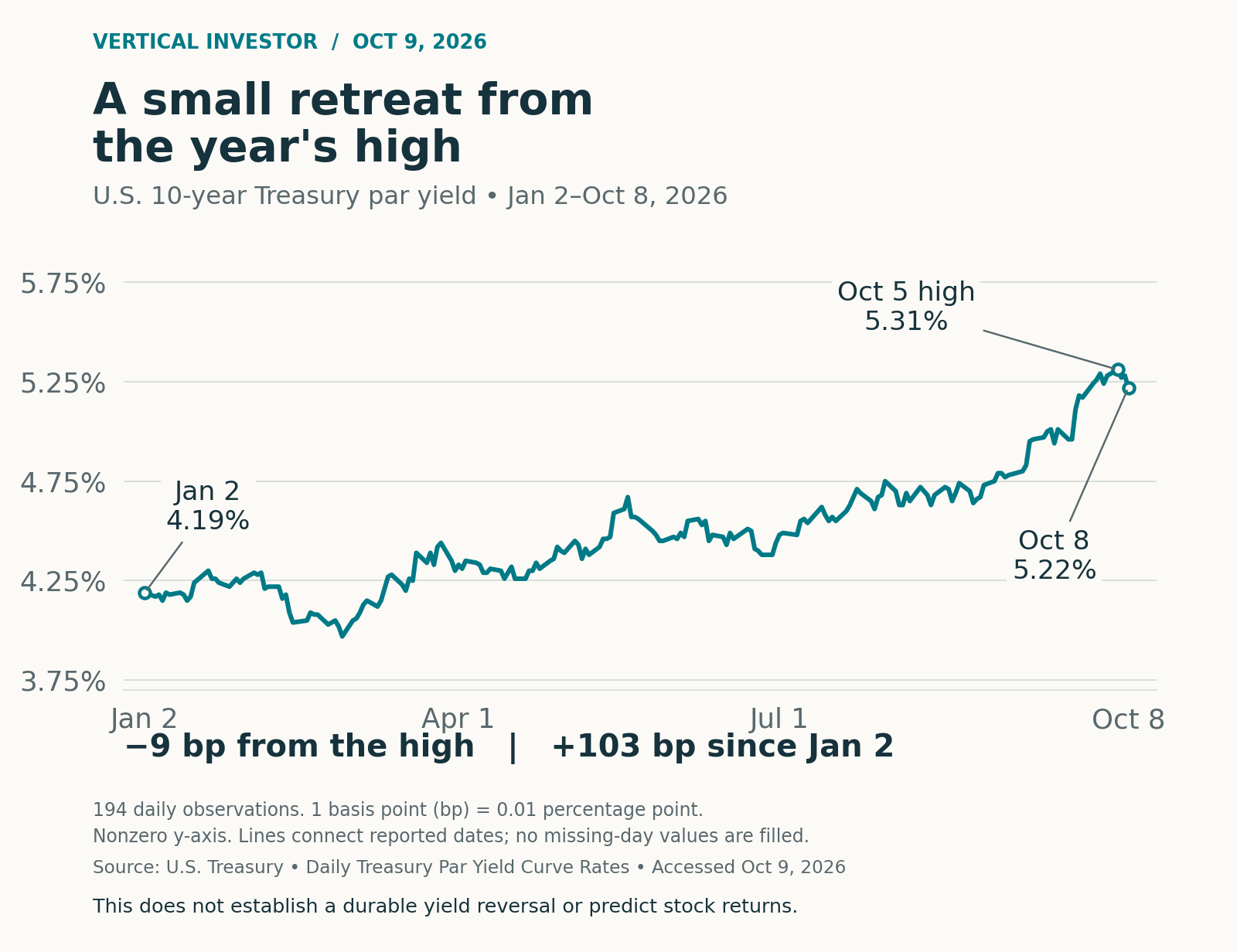
The takeaway: the benchmark yield has eased a little, but remains well above its start-of-year level. Daily 10-year Treasury par yields, in percent, January 2–October 8, 2026. Source: U.S. Treasury, checked October 9. The vertical scale does not start at zero. This shows the move, not its cause or what happens next. View full size.
For a homebuyer, a lower mortgage rate could mean a more manageable monthly payment. It will not change an existing fixed-rate mortgage automatically. Your actual offer also depends on your credit, down payment and loan terms. The CFPB explains those factors.
Where an opportunity could emerge
1. Businesses that help people buy and build homes. Builders and their suppliers could benefit if financing becomes more affordable and buyers still have secure jobs. Look for improving orders and profits that hold up. A builder can sell more homes by cutting prices; that is less encouraging if the discounts eat the profit.
2. Smaller companies with real customers and manageable debt. Less money spent on interest can leave more for equipment, hiring or shareholders. Start with businesses that already generate cash and can meet their obligations. Then ask which loans could actually become cheaper. Fixed-rate and variable-rate loans behave differently, as the SBA's loan guidance explains.
These are research candidates, not automatic winners. The company with the biggest debt problem is not necessarily the best way to benefit from lower rates. It may run out of breathing room before relief arrives.
The trap: falling rates, rising interest bills
Here is the detail a “rates down” headline can hide: companies often have to replace old loans when repayment comes due.
Take a simple hypothetical business with $10 million of debt at 3%. Its annual interest bill is $300,000. If it replaces that loan at 5%, the bill becomes $500,000. Even if available rates have fallen from 6%, it still owes $200,000 more interest each year than on the old loan. This simplified example assumes the debt amount stays unchanged and excludes fees.
That is why the repayment timetable matters as much as the direction of rates. For an investor, the useful question is: “What will this company's actual interest bill look like?”
Watch the customers as closely as the rates
Lower rates are most encouraging when inflation eases and customers keep buying. They are less reassuring when investors are rushing into government bonds because they fear a recession. If sales fall sharply, cheaper borrowing may not make up the difference.
A useful cross-check is whether lenders are demanding a bigger premium to finance companies rather than the government. That gap, comparing bonds of similar maturity, is called a credit spread. A widening gap would weaken the optimistic story. If rates simply stay high, businesses able to fund themselves from their own cash have more room to wait.
What to do with this now
Pick one business you understand and answer four questions before treating cheaper money as a reason to invest:
- How does it benefit? More affordable purchases for its customers, a smaller interest bill, or both?
- When does its debt come due? Compare the old borrowing rate with what a replacement loan could cost.
- Are customers still buying? Check the latest results for orders, sales and cash generated by the business.
- What does the share price already assume? Test whether the investment still makes sense if improvement is slower than hoped.
Next week's checkpoint is JPMorganChase's October 13 earnings release. Look for what it says about loan demand and borrowers struggling to repay. One bank will not settle the argument, but it can help test whether customers are holding up.
The opportunity worth investigating: a sound business gaining financial breathing room before that improvement is fully reflected in its share price. The work starts with its customers and its next interest bill.
General educational research, not personal investment advice or a recommendation to buy or sell. Outcomes are uncertain and investments can lose value.