What Does the AI Boom Earn for One Share?
Revenue can double while an existing share earns less. Follow one fictional AI infrastructure business through dilution, cash demands and the evidence that would justify its expansion.
Suppose an AI infrastructure company reports twice last year's revenue. Its customer list is longer, its facilities are expanding, and management has another impressive backlog number.
You can believe every word and still have an unanswered investment question: how much better off is the owner of one existing share?
That question matters because a company can grow in several directions at once. Sales can rise. Equipment spending can rise. The number of people sharing the eventual profits can rise, too.
The practical challenge is to separate evidence that the business is getting bigger from evidence that your ownership is becoming more valuable.
Keep your share count still
A share represents an ownership interest in a company, not a fixed percentage of its future success. That distinction is central to the SEC's basic explanation of stock ownership. Investor.gov: Stock
If you own 100 shares today and still own 100 shares next year, your personal share count has not changed. But the company's total might have.
New shares can finance facilities, acquisitions or other expansion. They can also form part of employee compensation. The relevant question is what those additional shares help the business earn, compared with the extra ownership claims they create.
A useful reading habit is to put total earnings beside diluted earnings per share. The latter accounts for the relevant share denominator, including potentially dilutive instruments under the applicable accounting rules. The IFRS Foundation's IAS 33 overview explains why the weighted-average share count and its reconciliation matter. IFRS Foundation: IAS 33
A fictional example you can reproduce
These figures are invented. They describe no listed company and are not a forecast.
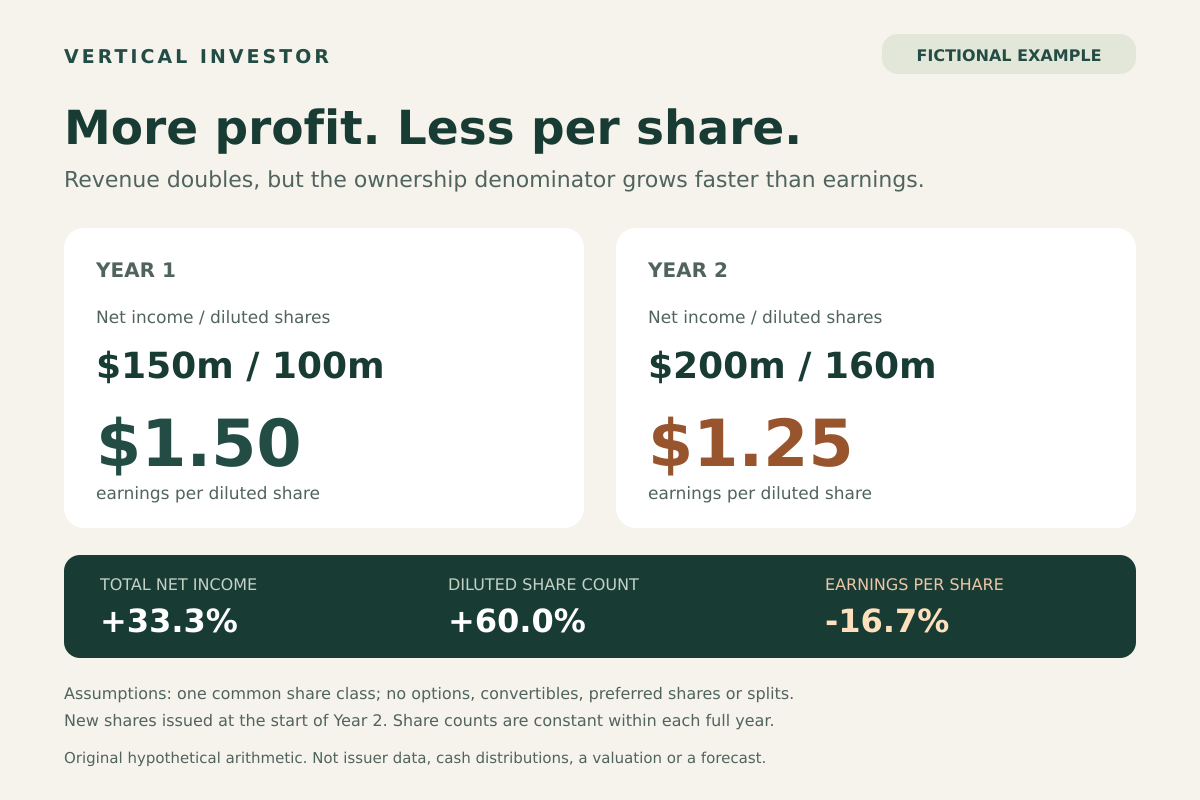
Assume one class of common shares, no preferred shares, options or convertible securities, and no stock split. All new shares are issued at the start of Year 2, so the share counts below apply for each entire year. Basic and diluted share counts are identical in this simplified case.
| Measure | Year 1 | Year 2 |
|---|---|---|
| Revenue | $2 billion | $4 billion |
| Net income attributable to common shareholders | $150 million | $200 million |
| Weighted-average diluted shares | 100 million | 160 million |
| Earnings per diluted share | $1.50 | $1.25 |
The arithmetic is straightforward:
- Year 1: $150 million / 100 million shares = $1.50.
- Year 2: $200 million / 160 million shares = $1.25.
- Change: ($1.25 / $1.50) - 1 = approximately -16.7%.
Revenue doubled. Total profit increased by a third. Yet each existing share represented less annual profit because the share count increased faster.
Your unchanged 100 shares would represent $150 of annual earnings in Year 1 and $125 in Year 2. Those are allocations of accounting earnings, not promised dividends or cash deposited in your account.
This proves a narrow point: strong company-level growth does not guarantee stronger per-share results. It does not prove that the new shares destroyed value.
Then ask where the cash went
Earnings alone cannot settle the question.
The cash flow statement separates operating activity, investment in assets and financing. Cash raised by issuing shares belongs in financing; it is not cash earned from customers. Purchases of equipment appear in investing activity. SEC: Beginners' Guide to Financial Statements
Extend the fictional example. Operating cash flow rises from $300 million to $420 million. Cash capital expenditure rises from $250 million to $380 million.
Subtract the second number from the first. The remainder falls from $50 million to $40 million, despite the increase in reported profit.
That calculation is only a starting point. Other obligations can still have claims on the money. The SEC specifically warns against treating free cash flow as automatically available for discretionary spending. SEC: Non-GAAP Financial Measures, Question 102.07
For an infrastructure owner, the difficult judgment is how much spending builds genuinely additional earning capacity and how much merely keeps the existing business competitive. Calling expenditure "growth investment" does not answer that question. Nor does one cash-heavy construction year prove the investment is poor.
The strongest case for accepting dilution
New shareholders bring resources as well as claims.
Suppose the fictional company's expansion eventually lifts annual net income to $300 million without further share issuance. With 160 million shares, earnings per share would reach $1.875, or about $1.88. That is 25% above the original $1.50.
That improvement alone would not prove the expansion created value: how long it took, the funding terms and the risks still matter.
Existing owners could benefit from an investment that initially diluted their earnings. A company with profitable expansion opportunities may also sensibly retain cash rather than distribute it.
The important countercase is therefore concrete: today's funding creates assets that generate enough additional, durable earnings and cash to compensate existing owners for the smaller percentage they retain.
That case becomes more persuasive when completed facilities produce cash, their upkeep costs become clearer, and further expansion depends less on repeatedly issuing stock.
What would change the conclusion?
For a particular company, we would become less concerned about dilution if several reporting periods showed:
- Earnings growing faster than the diluted share count.
- Operating cash generation supporting capital needs without increasingly relying on new financing.
- Completed investments delivering the economics originally described, including replacement costs.
- Clear explanations of share issuance, employee awards and repurchases, rather than celebrating buybacks while overlooking new shares.
The opposite evidence would strengthen the concern: expansion repeatedly requiring fresh equity, completed assets needing more cash than expected, or per-share earnings failing to catch up.
Price still matters. Even improving ownership economics can disappoint someone who paid for much faster improvement. A rising earnings stream and a falling valuation multiple can coexist.
The AI buildout can succeed while particular shareholders receive disappointing returns. The next time a growth headline catches your attention, carry one unchanged share through the numbers. Ask what it earns, what spending supports those earnings, and how much future success its price already assumes.