JPMorgan vs Bank of America: what are you paying for?
JPMorgan carries a premium. Bank of America has more to prove. A clear earnings-season test of valuation, credit losses and durable profits.

12 October 2026 | The Vertical Investor Editorial Desk
A bank can report a smaller expense for bad debts even when the amount it writes off barely falls. If you buy the stock on the reassuring headline alone, you could be paying for an improvement that is less durable than it looks.
That is a useful test this week. JPMorgan Chase reports on Tuesday, October 13; Bank of America follows on Wednesday, October 14. Their third-quarter results are still ahead of us.
Our investment question: is it better to pay a premium for JPMorgan's stronger recent profitability, or pay less per dollar of reported equity for Bank of America and look for improvement? The answer depends on what can last, what could go wrong and how much optimism is already in the shares.
Two banks, two very different price tags
At the October 9 regular-session close, JPMorgan was $332.99 and Bank of America was $54.32. The smaller share price does not make a stock cheaper. The useful comparison is what you pay for the business behind each share.
One starting point is tangible book value: the accounting equity belonging to ordinary shareholders after removing goodwill and specified intangible assets. Using each bank's June 30 figure:
- JPMorgan: about 2.94 times tangible book, using $113.35 per share.
- Bank of America: about 1.85 times tangible book, using $29.37 per share.
JPMorgan earned an annualized 23% return on tangible common equity in the second quarter after excluding its disclosed significant gains; Bank of America's reported measure was about 17%, up from 13.6% a year earlier. This measures profit relative to the tangible equity supporting the business. The banks use company-defined, non-GAAP measures, with different adjustments. They describe one quarter's business performance, not your stock return or a forecast. Sources: JPMorgan's supplement and Bank of America's supplement.
The tradeoff is real: JPMorgan has delivered higher returns, and investors pay more for them. Bank of America costs less per dollar of reported tangible equity, but has more to prove.
The profit improvement worth checking twice
Start with two terms. Net charge-offs are recognized write-offs after recoveries. The credit-loss provision is the expense recorded for expected losses. It also reflects changes in forward-looking reserves, which are accounting allowances, not a separate pot of cash.
In the second quarter, JPMorgan's provision fell $334 million from a year earlier. Only $44 million of that improvement came from lower net charge-offs; $290 million came from a smaller reserve build. At Bank of America, the $226 million reduction split evenly between lower net charge-offs and a shift from building reserves to releasing them.
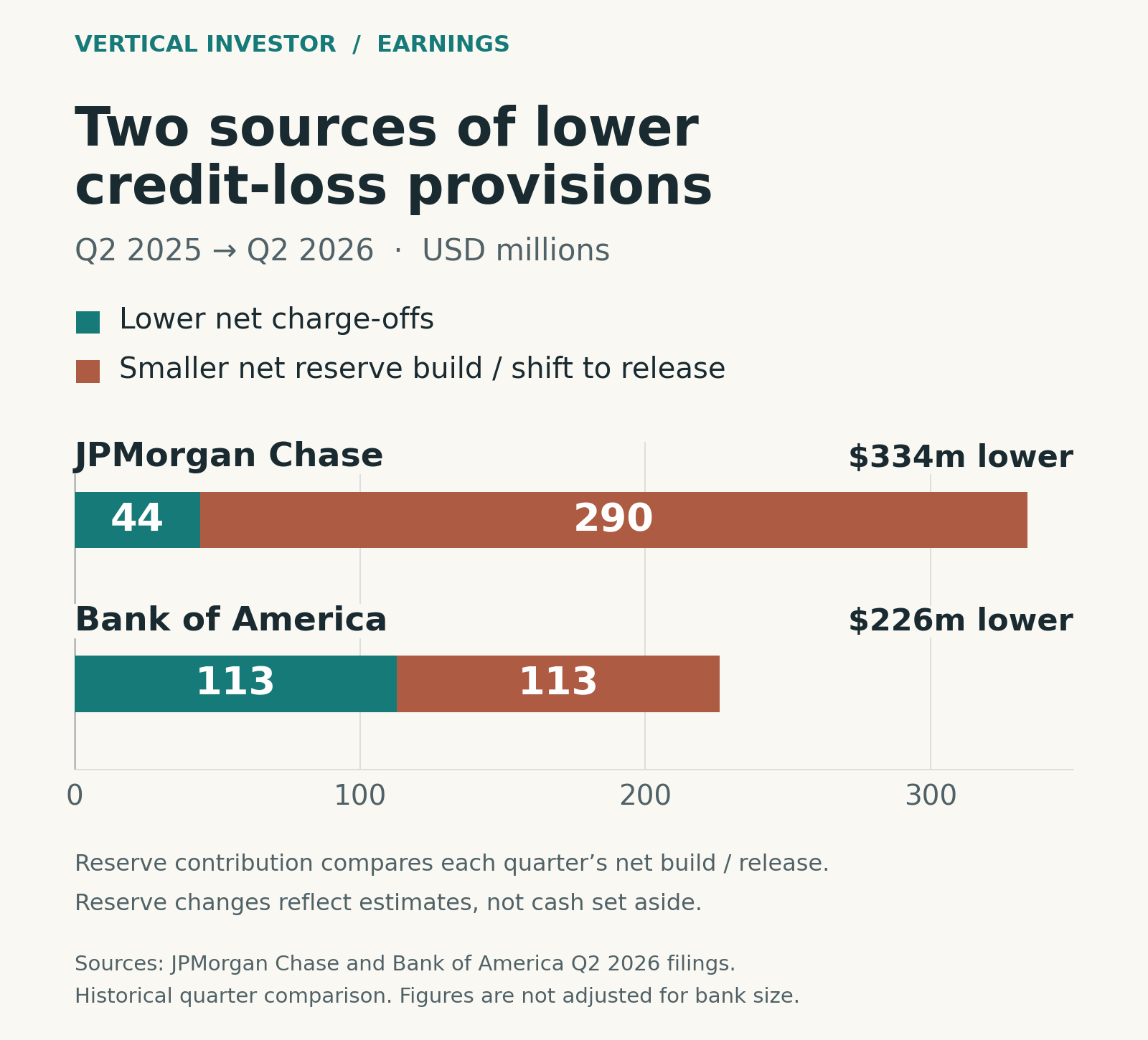
What the chart shows: lower credit-loss expense does not necessarily mean an equal improvement in actual write-offs. Figures compare Q2 2026 with Q2 2025, in millions of dollars. Calculations use JPMorgan's reported results and Bank of America's results and reserve definition. This is an expense comparison, not a ranking of bank safety or a forecast.
Reserve changes can be justified by the economy, borrower quality and lending growth. They are not evidence of wrongdoing. But an investor should ask whether profit improvement is supported by stronger everyday business as well as revised estimates.
What would make each investment case stronger?
JPMorgan: make the premium earn its keep. Its second-quarter headline profits included substantial gains connected to Visa shares and other equity investments. The more useful test is whether strong returns persist without needing those gains. Tuesday's case strengthens if net interest and fee income hold up while credit losses remain controlled. It weakens if underlying profitability fades while favorable estimates or investment gains carry the headline. At nearly three times June tangible book, there is room for the valuation to fall even if the bank remains profitable.
Bank of America: look for improvement that reaches shareholders. Its second-quarter net interest income, interest earned less interest paid, rose about 9% from a year earlier to $16.0 billion on the GAAP accounting basis. The opportunity to investigate is whether that growth can support better returns without being swallowed by operating expenses or bad debts. Wednesday's case strengthens if net interest income and returns keep improving with sound credit and capital. It weakens if that progress stalls or losses accelerate.
Its lower multiple also needs a balance-sheet check. At June 30, bonds classified as held to maturity had a carrying value of $505.8 billion and an estimated fair value of $423.7 billion, a gap of about $82.1 billion. That is not automatically a realized loss or a dollar-for-dollar deduction from shareholder value. It does show why reported book value is not a cash-out value. The quarterly filing shows the distinction. A lower multiple alone does not establish a bargain.
What to do with this now
Before reacting to either report, write down three questions: did underlying earning power improve, are credit losses contained, and does the share price leave room for disappointment?
Here is why the last question matters. If tangible book value per share grows 10% but the price investors pay for each dollar of it falls 20%, the share price falls 12%, before dividends. That is a hypothetical calculation, not a forecast for either bank.
Our watchlist preference is to investigate Bank of America's profitability-improvement case first, while using JPMorgan as the higher-return comparison. That is a research priority, not a buy call. This week's results need to show that the improvement is real, and the valuation still has to offer enough reward for the risk. Waiting for those facts is an investment decision too.
Prepared with AI-assisted research, primary-source checks and an independent factual/editorial review. Read about our research approach. General educational analysis, not personal investment advice. Prices are dated; outcomes are uncertain and investments can lose value.