Nuclear power’s boom: who gets paid before the reactors arrive?
Nuclear demand can grow while shareholders finance the wait. NuScale and Cameco reveal who pays, who gets paid and what must change.
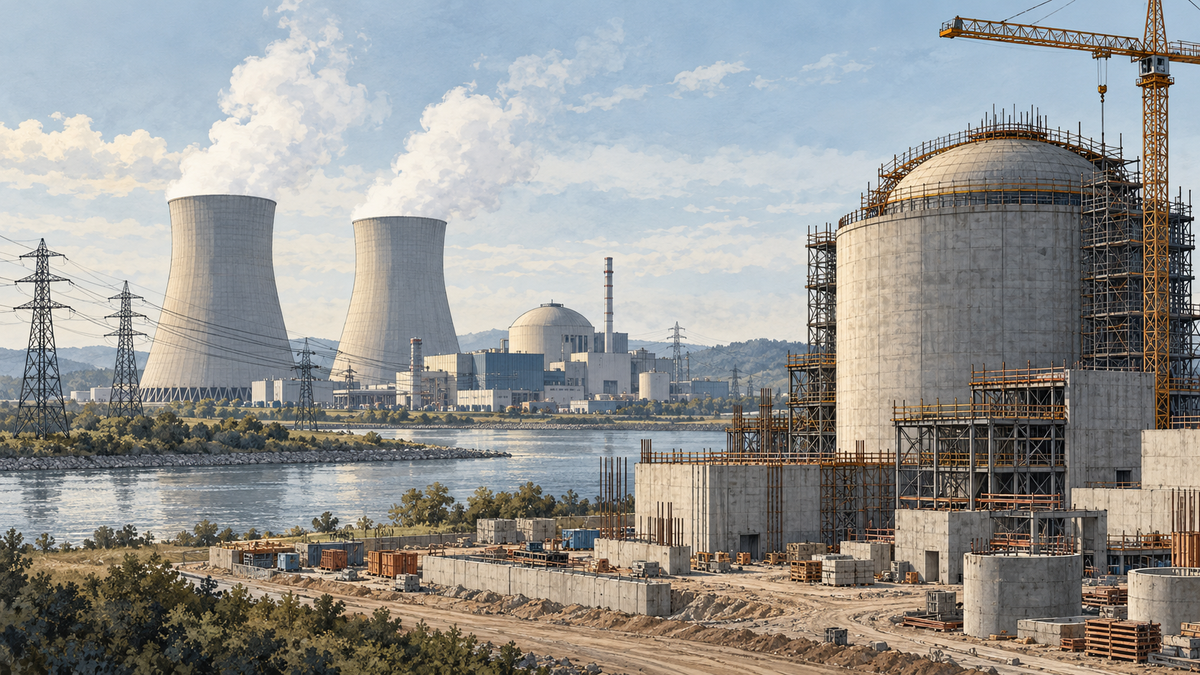
The world can need more nuclear power while nuclear shareholders finance years of waiting. The uncomfortable question is who collects money along the way, and who keeps writing checks.
NuScale offers a striking example. Its latest financial filing describes a commercial milestone built around a non-binding agreement that nevertheless triggered a substantial payment obligation. A promising future customer relationship can cost money long before it produces reactor sales.
Our working view: the commercial evidence in this comparison favours an operating nuclear supplier over assuming a reactor developer’s potential orders will reward shareholders. Cameco and NuScale show why. That does not establish that Cameco shares are attractively priced: valuation is a separate, untested question.
The demand story is real. The timetable is negotiable.
The International Energy Agency’s October 14 report describes AI investment straining local grids and equipment supply chains. It also warns that connection queues include speculative or duplicate projects. Electricity demand arriving at the wrong place or time creates a problem, but an announced data centre is not automatically a future nuclear customer.
That matters because an investor buys a claim on one company’s eventual earnings. Demand must become a financed project, an enforceable order, delivered work and cash left after costs. There are several places for that chain to break.
For a reactor developer, a delay can mean another year of payroll and development spending. For a fuel supplier, existing reactors can provide customers while the next generation is being planned. Neither route escapes commercial risk.
NuScale: read the direction of the payment
NuScale’s June 30 filing records a US$507.4 million expense in 2025 under its ENTRA1 partnership agreement after a non-binding agreement covering 72 modules. US$259.9 million of that obligation was paid in the first half of 2026.
First-half operating cash use was US$372.9 million. The earlier expense’s settlement explains much of that cash outflow; it would be misleading to call the entire amount a normal, recurring six-month burn rate. Later contractual milestones can require additional payments. ENTRA1 retains discretion over selecting and purchasing NuScale equipment.
NuScale also raised US$984.5 million net through common-share issuance during the half. That supplies capital while spreading ownership across more shares. The relevant question is whether what the money builds ultimately adds enough value for each share.
There is no basis here for a simplistic “running out of cash” story. NuScale’s August 5 results reported US$1.9 billion in cash, cash equivalents and short- and long-term investments at June 30. Calling all of that cash would be inaccurate. The same update said ENTRA1 and TVA were still discussing a definitive power purchase agreement, the contract governing electricity sales.
NuScale has achieved meaningful technical progress. The Nuclear Regulatory Commission approved its US460 standard design in May 2025. Design approval allows a project to use that reviewed design in licensing. It is not permission for a particular plant to start operating.
There is a timely warning from a prospective project. In an October shareholder note, Romania’s Nuclearelectrica (SNN) said more than 80% of conditions attached to the Doicești investment decision remained unmet. One requested safeguard would delay paying for five modules until the first is fully operational; the alternative would require NuScale to reimburse the cost of those five if the first fails to work as designed. SNN proposed temporary activity and staffing cuts for an October 29–30 shareholder vote. Its strategy review retained NuScale as an option.
These distinctions change how to read the next announcement. An agreement’s size matters less than its obligations: who must fund it, when payments become due, and what happens if the project slips. A signed document can move commercial risk around without removing it.
Cameco: customers exist, but cash still has to travel
Cameco gives investors a different starting point. Its July 31 results reported 7.1 million pounds of uranium delivered in the second quarter and contracted annual deliveries averaging more than 28 million pounds over the next five years. Timing varies. Those are existing commercial relationships rather than a forecast that new reactors eventually need fuel.
The route to benefit is tangible: obtain uranium at an economic cost, deliver it under customer contracts and retain a margin. More favourable contracting can improve that business. But an attractive industry does not make every sale profitable or every receipt available to shareholders.
In its June financial statements, Cameco reported first-half operating cash flow of C$108.8 million and property, plant and equipment additions of C$184.2 million. Subtracting those gives roughly negative C$75 million, a simple cash-after-capital-spending comparison before financing cash flows, including interest paid. It is not a company-reported free-cash-flow measure. Delivery schedules, taxes and working capital affected this half-year; it does not establish a normal annual cash-flow level.
The same report contains a useful surprise: its 2026 sensitivity analysis showed a higher spot uranium price could reduce near-term cash flow, because purchase costs and contractual sales prices respond differently. Later dividends from its uranium joint venture can partly offset that timing effect. “Uranium up” is not a complete earnings model.
Cameco also owns 49% of Westinghouse, giving it exposure to reactor technology and services. On September 30, Cameco welcomed a US–Korea framework anticipating US$120 billion toward reactor deployment. Its terms were explicitly non-binding, with definitive agreements, sites, approvals and financing still required. That headline is potential expansion, not money already earned by Cameco.
The strongest argument against being cautious
Waiting for every uncertainty to disappear can mean waiting until much of the opportunity has been priced in. A successful early reactor programme could establish a repeatable product and a customer base that later projects build upon. Financing the first difficult years may be economically sensible if the business ultimately earns enough.
Established suppliers can disappoint too. Contract protection may limit upside, operating problems can consume cash, and a strong business can still be an expensive investment. The company with the most visible customers is not automatically the stock with the most upside.
That is why our view would change with evidence about who carries the remaining risk. For NuScale, funded, binding orders with understandable payment and cancellation terms would carry more weight than another large prospective deployment announcement. Our preference for operating suppliers would weaken if repeated delivery shortfalls or procurement costs prevented acceptable cash generation across a full delivery cycle.
What this means for an investor
The useful distinction is between financing nuclear capacity that might arrive and supplying capacity that already needs to run. Both can create value. They require different assumptions, different patience and different compensation for risk.
For now, the operating supplier has the stronger commercial foundation in this comparison. A developer’s project pipeline still needs to earn its way from possibility to funded orders. Neither conclusion tells us what price makes the shares worth owning.
The nuclear opportunity may be substantial. The shareholder’s opportunity depends on the price paid, the bills still to come and how much of the eventual business each share owns.
C$ denotes Canadian dollars. Financial reporting here is through June 30, 2026; selected subsequent official disclosures were reviewed through October 18. This is general research, not an individual investment recommendation.