When an ETF Discount Isn't a Bargain
A fund priced below its published asset value may look cheap. Three fictional outcomes show why the gap can vanish while the buyer earns nothing—or loses money.
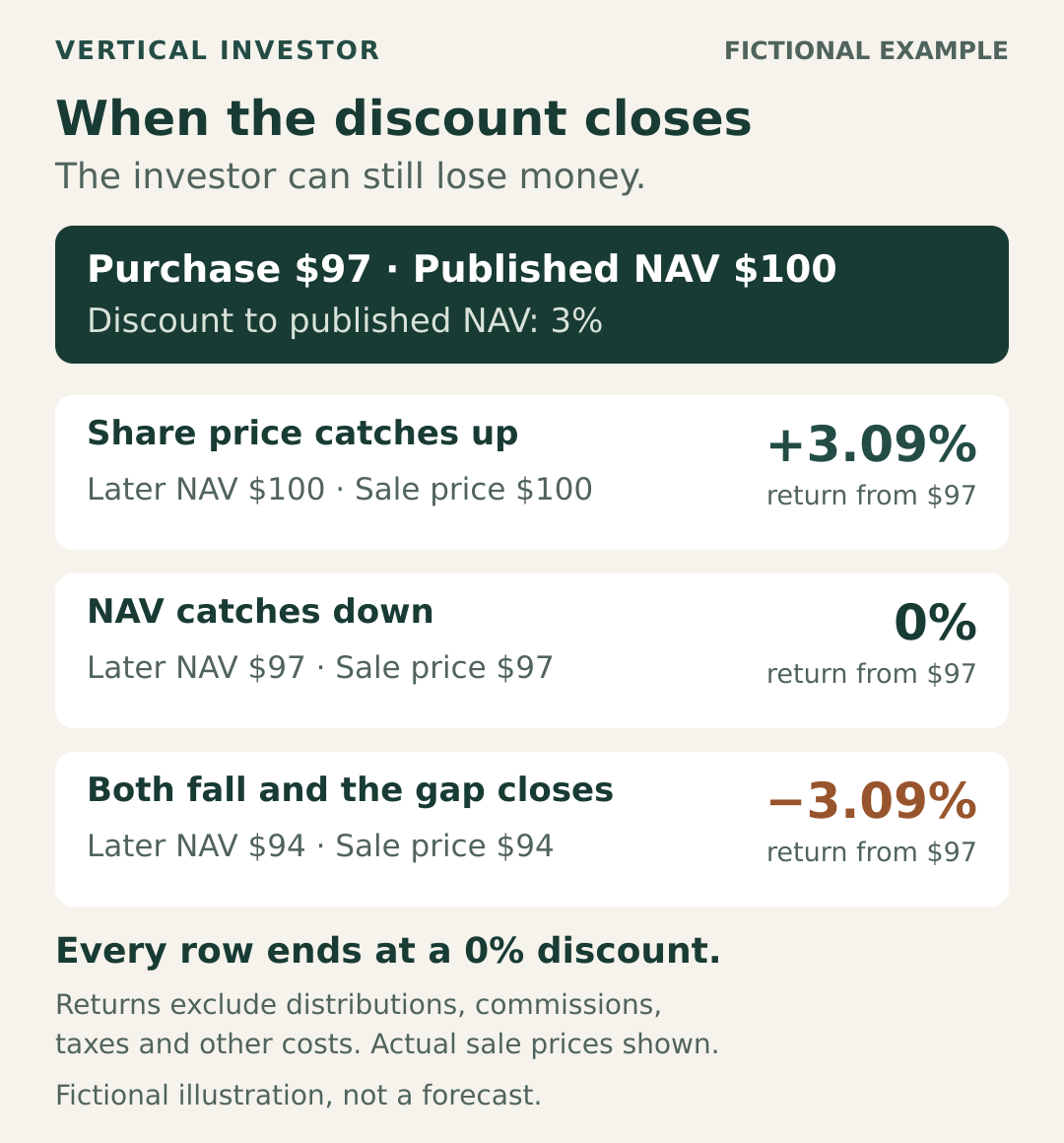
A fund's shares trade at $97. Its latest published net asset value is $100. The apparent opportunity is easy to describe: buy a dollar's worth of assets for 97 cents.
But that description leaves out the most important question. Could those assets actually be sold for the published value, at the same moment you could buy the fund?
An exchange-traded fund's discount can narrow because its share price rises. It can also narrow because the reported value of its holdings falls. One outcome rewards the buyer. The other may merely confirm what the market already suspected.
For anyone using ETFs to move between markets, the distinction matters. A cheap-looking entry can be a stale comparison rather than a genuine margin of safety.
Two prices answering different questions
Net asset value, usually shortened to NAV, is the value of a fund's assets minus its liabilities, divided by its shares outstanding. U.S. registered ETFs calculate it each business day. Their shares, meanwhile, trade on an exchange throughout the trading day.
The SEC's investor bulletin explains that ordinary investors buy and sell ETF shares at market prices rather than redeeming individual shares directly with the fund. A published NAV therefore is not a standing offer to pay you that amount. SEC: Exchange-Traded Funds
Always attach a time to the comparison. A live quote beside yesterday's closing NAV mixes two observations. Even a same-day closing comparison can contain differences in how recently the underlying assets traded and how their values were estimated.
That is particularly important for bonds. Unlike a widely traded stock, an individual bond may not change hands frequently. Invesco's January 2026 explanation notes that some bonds trade infrequently and that ETF prices may incorporate information sooner than the prices used in NAV. It also describes the timing problem when an ETF trades while its overseas holdings' markets are closed. This is an issuer's explanation of the mechanism, not proof that every discount is harmless. Invesco: ETF net asset value
A discount can disappear three ways
Consider a fictional bond ETF. These figures describe no real fund and predict no market outcome.
At the initial observation, its published NAV is $100 and its executable purchase price is $97. Assume sufficient quoted size for the purchase. Its discount to that NAV is:
($97 / $100) - 1 = -3%.
Now compare three possible later outcomes. To isolate the mechanism, assume no distributions, commissions, taxes or other costs, and use the actual sale price for the exit.
| Later outcome | Later NAV | Sale price | Remaining discount | Return from $97 |
|---|---|---|---|---|
| Share price catches up | $100 | $100 | 0% | +3.09% |
| NAV catches down | $97 | $97 | 0% | 0% |
| Both fall, discount closes | $94 | $94 | 0% | -3.09% |
In every row, the discount disappears. Only the first produces a gain. The return calculations are $100/$97 - 1 and $94/$97 - 1, rounded to two decimal places.
Notice another denominator trap: a 3% discount does not mean an exactly 3% gain if the price reaches the old NAV. The gain is measured against the $97 paid, not the $100 reference value.
Why professional traders do not erase every gap
ETFs have a mechanism intended to keep market prices close to portfolio value. Large financial firms called authorized participants can create or redeem blocks of ETF shares. A discount may give them an incentive to buy shares and redeem them for a basket of assets or cash.
That trade must work after its real costs and risks. The basket available for redemption may differ from the fund's complete holdings, and selling its bonds may be expensive or difficult. BIS research published in 2021 explains how these features can weaken bond ETF arbitrage. It also notes that authorized participants are not legally obliged to close the gap. BIS: The anatomy of bond ETF arbitrage
So “the professionals will fix it” is an incomplete investment thesis. A price difference can persist when the trade is costly, uncertain or unattractive to the firms able to execute it.
The strongest case for buying a discount
A genuine opportunity is possible. If temporary selling pressure pushes the ETF below credible, current values for its assets, an investor might benefit when that pressure eases.
The stronger case would include current underlying transactions or executable quotes supporting those values, a functioning redemption process, manageable trading costs and a reason the imbalance should end. The investor also needs to withstand the possibility that the gap widens first.
The weaker case consists only of a large percentage on a website.
Historical evidence shows why that distinction deserves attention. Bank of England researchers studying March 2020 found that corporate bond ETF discounts contained information about subsequent NAV movements in comparable open-ended funds during the stress episode. They did not find that relationship in normal conditions. This was a particular historical result, not a reusable promise of what tomorrow's prices will do. Bank of England: ETF prices during the dash for cash
Read the quote, not just the discount
Before treating the gap as an opportunity, identify the NAV timestamp, how the fund values its holdings, and whether the quoted market price is a last trade, midpoint, bid or ask. The price available for your transaction can differ from the headline number. Commissions and other trading costs can absorb part of any apparent advantage. SEC: Fund fees and expenses
We would become more persuaded by a discount if fresh underlying evidence continued to support the higher value while transaction costs stayed contained. Falling underlying prices, widening spreads or problems with redemptions would weaken the case.
The useful question is not simply how far the ETF sits below NAV. It is which number is likely to move, why it should move, and how much of that change an investor could actually keep.